

Dentures have been helping patients regain their confidence and ability to chew their favorite foods for many years. Across the decades, they have evolved to become more functional and natural-looking than ever before. At New Haven Dental Group, we proudly offer both full and partial dentures to patients who have lost multiple teeth. If you are missing several — or even all — of your teeth, one of these treatments may be suitable for you.

Almost anyone who has lost multiple teeth could benefit from dentures. Of course, when you visit us for your consultation, we will carefully examine your gums and other aspects of your oral health to determine if your mouth can support a prosthetic. From there, we can discuss your treatment options. Even if you are not a candidate for dentures right away, you may become one after some strategic preparatory procedures.

Missing teeth can be the result of numerous factors. For example, genetics, gum disease, accidents, and lifestyle factors can all contribute to tooth loss. Regardless of what caused your current condition, you may face some significant challenges because of it.
For example, you might feel self-conscious about the appearance of your smile and the hollowness of your cheeks. Because of that, you might shy away from social interactions and miss out on meaningful relationships. Additionally, a lack of ability to enjoy your favorite foods may lead to a degree of malnourishment and dissatisfaction with your diet.
The good news is that dentures can often help to correct such issues.

You may qualify for dentures if:
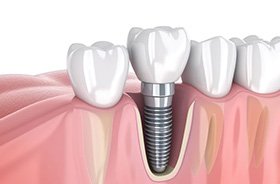
If dentures are not quite right for you, you might be a good candidate for an alternative form of tooth replacement, such as:

A full denture is a removable prosthesis that replaces an entire arch of missing teeth. It consists of a gum-colored base and a row of artificial teeth, which are usually made out of porcelain or acrylic. Natural suction or a mild adhesive helps a full denture to remain in place.
A partial denture replaces several missing teeth at various places throughout a dental arch. You can think of it like a puzzle piece that fits in exactly where it is needed. It allows patients to retain their remaining natural teeth while still enjoying all the benefits of a denture. Small attachments help a partial denture to remain secure in the mouth during eating and speaking.
Many patients are candidates for implant-supported dentures, which are anchored in the jawbone via small titanium posts. This page focuses primarily on traditional dentures, but you can read more about dental implants and their many benefits on our website’s dental implant page.
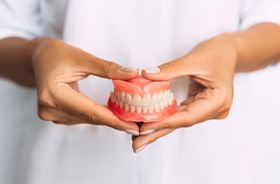
Once you make the decision to move forward with dentures, you are beginning an exciting journey toward restoring your smile and your confidence. Understanding what goes into creating your custom prosthetic can help you feel more comfortable and informed throughout the process. You may wonder what materials will be used, how the dental laboratory will craft your new teeth, and what to expect from start to finish. The information below walks you through this fascinating process.
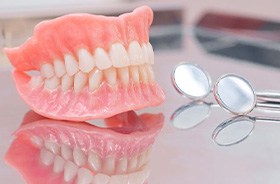
Dentures are composed of two primary components, each of which are chosen for comfort and function:
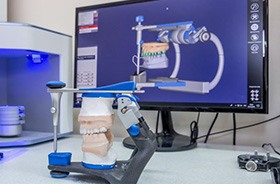
The process of making dentures involves several stages, each designed to deliver a prosthetic that is tailored specifically to your mouth. Here is a general outline of the steps you will go through:
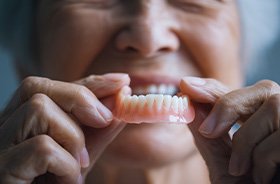
Although dentures are custom-crafted to fit your mouth, it is normal to experience some initial discomfort as you adapt to them. You may notice mild soreness or find that speaking feels different at first. By wearing your dentures consistently each day, you will give your mouth a chance to adjust, and you will likely discover that they begin to feel more comfortable and natural over time. If you have questions or would like advice on making the adjustment period smoother, you are encouraged to reach out to our dental team for support and guidance.

Tooth loss can have profound consequences on your daily life. It may adversely affect your confidence, your self-image, your nutrition, your oral health, and other aspects of your wellness. The good news is that dentures can reduce or even eliminate many of the trials that result from edentulism (the state of being toothless). Would you like to learn more about dentures and how they might be able to benefit you personally? Continue reading below.

Multiple structures, including the teeth and tongue, play an important role in producing clear speech. Without teeth, you may find it difficult to enunciate certain sounds. Your speech might even sound a bit muddled. You may find such challenges to be embarrassing.
When you first get dentures, you might develop a slight lisp. After some time and practice, though, your speech should be clearer than it was before you got dentures.

You may qualify for dentures if:

Edentulism can make it difficult or even impossible to enjoy a wide variety of foods. You might miss out on the nutrients in items like fresh fruits and veggies, as well as certain types of meats. Your overall health could suffer as a result.
With dentures, you can look forward to enjoying a wide variety of snacks, meals, and treats. In fact, after you get used to eating with your prosthetic, very few foods will be off-limits for you.

If you still have some of your natural teeth, dentures might benefit you in at least two ways:

Sadly, poor oral health could adversely affect your career. Obvious tooth loss might even make it more difficult for you to secure a promotion or get a job with a new company! Dentures, on the other hand, can help you to convey a powerful and positive impression. They can send the message that you are youthful, successful, and approachable. They might just give you the added advantage you need to achieve your goals.
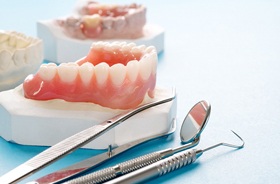
The denture process is not the same for every patient. Some individuals must first undergo tooth extractions. Following the extractions, you may have to wait several weeks while your mouth heals before our team can design your dentures. Or, you might opt for an immediate denture, which is placed on the same day as the extractions. An immediate denture must be adjusted soon thereafter to accommodate the changes in the mouth that happen following tooth extractions.
After you get used to using your dentures, you will still need to visit our team periodically for checkups and adjustments to your prosthetic. A traditional denture usually lasts for 5 – 8 years before changes in the patient’s mouth reach the point where minor adjustments are no longer able to make the denture fit well. Thereafter, you will have to get an entirely new denture.
Would you like to learn more about dentures and partial dentures and how they may be able to benefit you? Contact New Haven Dental Group today to schedule a consultation.

Even if you no longer have any of your natural teeth, you still need to take care of your smile! A major component of doing so is attending regular checkups with our dental team. During these appointments, not only will we check on the health of your gums and other oral tissues, but we will also help you to keep your prosthetic in good shape. From time to time, it may need to be relined (adjusted), and we want to stay on top of maintaining it!
Of course, dental checkups are just one aspect of keeping your smile in good shape. Here are some additional tips for dentures aftercare.
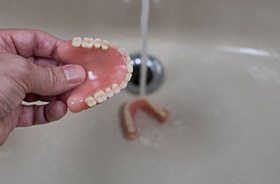
It is a wise practice to remove your dentures after each meal so you can rinse them. This helps to remove food particles and bacteria, which reduces the risk of bad breath, denture sores, and other issues. Keep in mind that you should not use hot water for this; high temperatures could warp your dentures and cause them to lose their snug and comfortable fit.
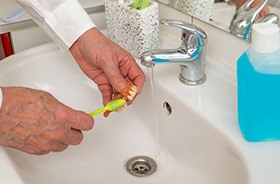
Even if you are diligent about rinsing your dentures after each meal, you should still take time to thoroughly clean them each night. Use a soft-bristled brush and a mild cleaning agent to scrub all their surfaces. (Do not use regular toothpaste because it is too abrasive.) You should also regularly soak your dentures in a cleansing solution, which can help with deeper cleaning. Be sure to rinse your dentures before placing them back in your mouth.
To protect your dentures from damage, you should:

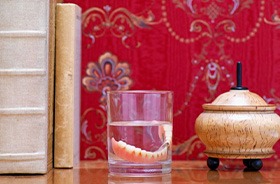
You should not sleep while wearing your dentures. Doing so could place extra stress on your gums and interfere with blood circulation. Studies have even shown that sleeping with dentures is associated with a higher risk of oral plaque and pneumonia. In contrast, removing your dentures at night allows you time to thoroughly clean them and gives your gums a chance to rest. Store them in water or a cleansing solution overnight so they do not dry out and lose their shape.

If you ever notice any significant changes in your dentures or oral tissues, you should schedule a dental appointment right away. For example, you should visit us if:

In many ways, caring for All-on-4 dentures is similar to caring for natural teeth. You should:
The average wait time between tooth extractions and denture creation is usually 6 – 8 weeks. This allows time for your gums to heal before you get your new teeth; it also helps to make sure that your prosthetic fits well.
Some patients qualify for immediate dentures, which are created before tooth extractions and ready to wear immediately afterward. Immediate dentures do not last as long as traditional ones, and their fit may change quite a bit as your mouth heals from your tooth removal procedure.
If you are getting permanent implant dentures from our New Haven team, you may have to wait several months between your extractions and when you receive your new teeth. However, if you get All-on-4 dental implants, you may get your dentures on the same day as your extraction procedure.
If your dentures break, call our New Haven team. Bring your broken prosthetic with you and, if possible, we will try to make repairs in-office. Otherwise, we might have to send your dentures to a laboratory for repairs or possibly even replace them altogether.
It is important that you do not try to repair your dentures on your own. Using household items, such as superglue, could actually worsen the damage. Plus, putting such items in your mouth could expose you to toxic substances. It is best to leave all denture repairs to professionals.
When you first get your dentures, they should be the right shape and size for your unique mouth. As time passes, however, you may find that they become looser or no longer seem to fit right. This is a normal occurrence. It happens because the jawbone naturally shrinks and changes shape after the removal of natural teeth.
To get your dentures to fit well again, you should bring them to our office. We may be able to reline them, which means we can add material to their base so they fit snugly and comfortably once again. Eventually (usually after 5 – 8 years), relining may no longer be an effective option. You will need to get completely new dentures.
A quick online search will reveal that some companies sell DIY denture reline kits. This may seem like a more convenient and affordable option to adjust the fit of your prosthetic.
We advise extreme caution. Without professional training, there is a chance that you could use too much of the relining material or apply it unevenly. As a result, the way your denture fits may actually worsen. You may even end up needing to replace your dentures sooner than expected.
Professional relines yield much more reliable results.
When you first get your dentures, we might encourage you to wear them for 24 hours. After that initial period, though, you should take them out of your mouth nightly. Doing so offers some big advantages:
8:00am - 5:00pm
8:00am - 5:00pm
8:00am - 5:00pm
8:00am - 5:00pm
8:00am - 5:00pm
Closed
You are being directed to a secure payment site.
Redirecting in seconds...